
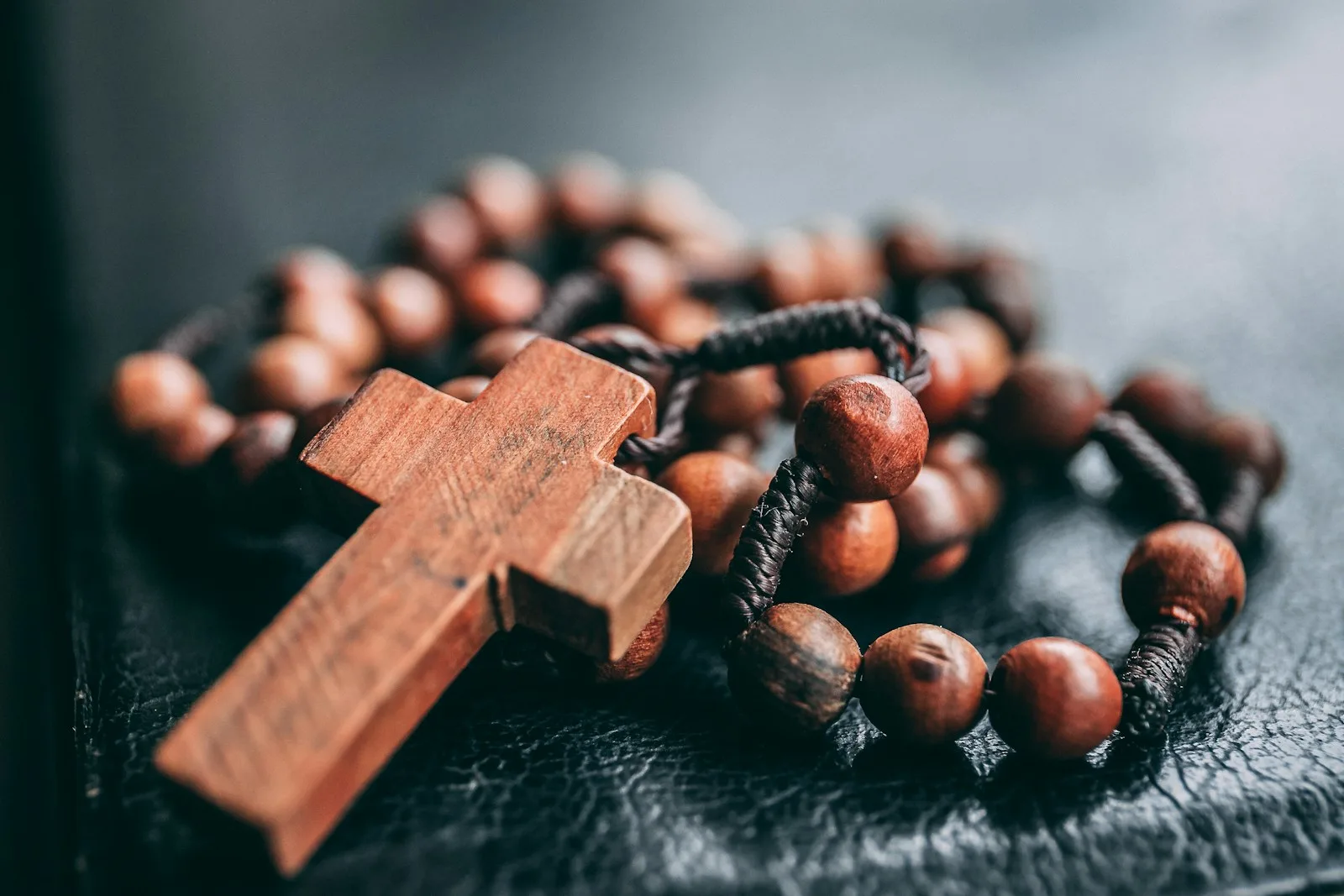
Oct 15 St Teresa of Avila, (3) religious and Doctor of the Church 1515-82
A Story of Teresa of Avila
‘There’s a lovely story told about the life of St Teresa, one handed down to us by tradition. Bishop Philip Boyce of Raphoe retells us .
‘One day as Teresa was making her way along the corridor in the convent of the Incarnation, in Avila, she saw a small boy standing at the foot of the stairs,’
‘Who are you?’ the child asked her.
‘I am Teresa of Jesus’, she told him
‘And who are you? asked Teresa
‘I am Jesus of Teresa’, the child replied, and vanished.
The story beautifully illustrates the deep love and friendship that existed between Teresa and the one she liked to call ‘the Good Jesus’
Indeed it was this passionate love for Jesus that filled her whole life. Despite bitter opposition, misunderstandings and poor health, she faithfully followed a divine call, filled with a burning love for the Lord.
Teresa was a woman of exceptional human qualities: warm and sociable, charming and intelligent. She had a great gift for friendship and had many friends. She loved life and all things human and she said herself she had little time for sour-faced saints. It’s little wonder that she has become one of the most endearing of all Christian saints and the most approachable of the mystics.
She was born in 1515, over five hundred years ago, in the walled city of Avila in Spain. At the age of twenty-one she entered the Carmelite convent of the Incarnation. She spent twenty years, she tells us ‘on a stormy sea’, torn by countless distractions and the endless comings and goings of the convent. But she always tried to be faithful to prayer and, in the end, it was prayer that enabled her to make a total surrender of herself to God. She fell in love with Jesus and there was no turning back. A new life and a new world opened up for her.
The resulting explosion of love and her desire to do ‘great things for God’ could not be contained within the enclosed walls of a convent but overflowed in action and love for the Church, namely, the foundation of the Carmelite reform.
Teresa spent the last twenty years of her life establishing the Carmelite reform throughout the length and breadth of Spain, from Burgos in the north to Seville in the south, a distance of three hundred miles. Each foundation brought its own hardship: negotiations with civil and ecclesiastical authorities, local opposition, misunderstanding, financial worries and exhausting journeys along winding roads and rough terrain. Before she died in 1582 there were seventeen convents of nuns and fifteen monasteries of friars stretching from one end of Spain to the other.
One of the other great legacies of Saint Teresa is her writings. These have enriched the Church for the past five hundred years. She was a reluctant writer at first but once she set her pen to paper she was on fire with inspiration. Her writings reflect, in a very personal way, the richness of her own spiritual journey and are a faithful witness to her own dynamic spirit. The ease and down-to-earth quality of her writing has made her one of best and surest guides in the restless searching of the human spirit. Little wonder that she was declared Doctor of the Church by Pope Paul VI in 1970 – the first woman to be given that title. She is one of the great mystical figures of the Church, not simply on account of the extraordinary graces she received, but more so because of her gift of being able to communicate and put into words what is almost beyond words.
Prayer is what she talks about most of all in her writings. For her, prayer was about friendship, friendship with the Lord. Like any friendship it grows by communication, and that’s what prayer was for her; a heart-to-heart conversation with someone she knew loved her.
So attractive is her message that many still follow her Carmelite way of life. Indeed, there may be some young women or young men tuned in to our broadcast this morning who feel called to a life of total dedication to God and to the Church in a Carmelite convent or monastery. Let them not be afraid to take the step.
But the greatness of Teresa is not in her achievements or in her writings, but in her own love of God. It is not what she tells us about herself that matters most but what she tells us of God. The essential witness of Teresa is to the reality of the spiritual world, a world in which God is encountered as real and personal, as someone who loves each one of us unconditionally and is intimately involved in the everyday realities of our lives.
‘God’, she tells us, has so many enemies and so few friends that these friends should be good ones. She certainly was a friend of God, a daughter of the Church and a servant of love. And she invites and encourages us to share that journey with her.
____________________________________
******************************
Memorable Saying for Today
‘God’, Teresa tells us,
‘has so many enemies and so few friends
that these friends should be good ones.’
******************************
Summary: St Callistus I, pope, martyr, died in a civil disturbance in Rome about 222 and venerated as a martyr since the fourth century. Born a slave and served a sentence as a convict. Afterwards ordained a deacon and eventually elected bishop of Rome. Rigorist opponents accused him of misunderstanding the doctrine of the incarnation and of laxity in Church discipline. Noted for encouraging the reconciliation of sinners and for his pastoral solicitude for those preparing to marry.
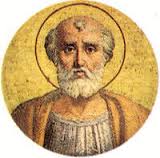
Patrick Duffy tells his story.
Early Life
Callistus seems to have been a slave in the Trastevere area of Rome whose earliest years seemed quite unpromising. Having defrauded his master, who forgave him, he went on to set up his own moneylending business. But when in eager pursuit of a Jewish client, he disturbed the rites of a Jewish Synagogue, he was arrested, convicted and exiled to the salt mines of Sardinia. On his return he worked for some time with the Christian community at Anzio.

By this time, however, he seems to have turned into quite a competent person. Pope Zephyrinus (119-217) brought him to Rome, ordained him and made him his administrator and advisor. He put him in charge of the cemetery and places of worship, which some wealthy people had made available to the Christians. St. Callistus at the beginning of the 3rd century AD, was assigned by Pope Zephyrinus to the administration of the burial ground . They were the official cemetery of the Church of Rome in the 3rd century AD. Around half a million Christians were buried here, among them many martyrs and 16 popes. They contain some of the most beautiful Christian art of the early Church.
As Pope
Callistus was himself elected pope in 217, but a minority followed the more rigorist Hippolytus as anti-pope, thus making Callistus’s papacy from 217 to 222 quite a controversial time. Hippolytus later wrote a biography of Callistus in which he accuses him of being too lenient – allowing priests and even bishops to marry, of being too easy with adulterers and prostitutes after they had done public penance.
Callistus’ Catacombs
St. Callistus at the beginning of the 3rd century AD, was assigned by Pope Zephyrinus to the administration of the burial ground . They were the official cemetery of the Church of Rome in the 3rd century AD. Around half a million Christians were buried here, among them many martyrs and 16 popes.
Death
Although Callistus is listed as a martyr, there was no persecution at that time, and it would appear that his death took place during a public riot against the Emperor Heliogabalus.
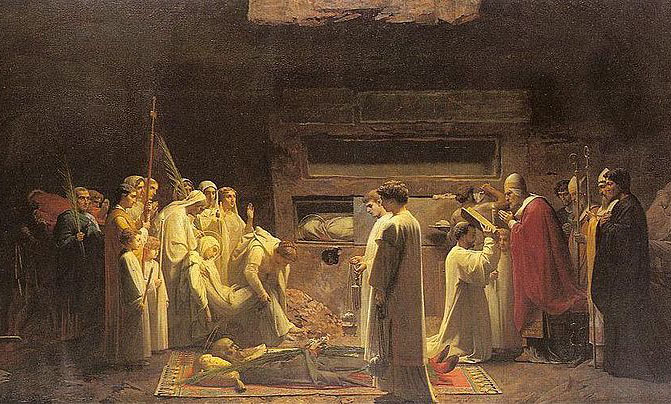
A solemn burial of an early Christian in Callistus’ time
The ‘Calistus’ Catacombs
The Catacombs of St Callistus is an extraordinarily complex network of underground chambers, the burial place that stretches for miles and is accessible at Via Appia Antica 110-126, Roma. They were re-discovered in the nineteenth century by Giovanni Battista Rossi (1822-94), the father of Christian archaeology. They contain some of the most beautiful Christian art of the early Church. Callistus, however, is not buried there, but on the Via Aurelia.
____________________________
******************************
Memorable Sayings for Today
The smallest act of kindness is worth more
than the greatest intention.”
~Oscar Wilde ~
“Every small, unselfish action
nudges the world into a better path.
“Be the reason someone smiles.
~ unknown ~
******************************